Menu
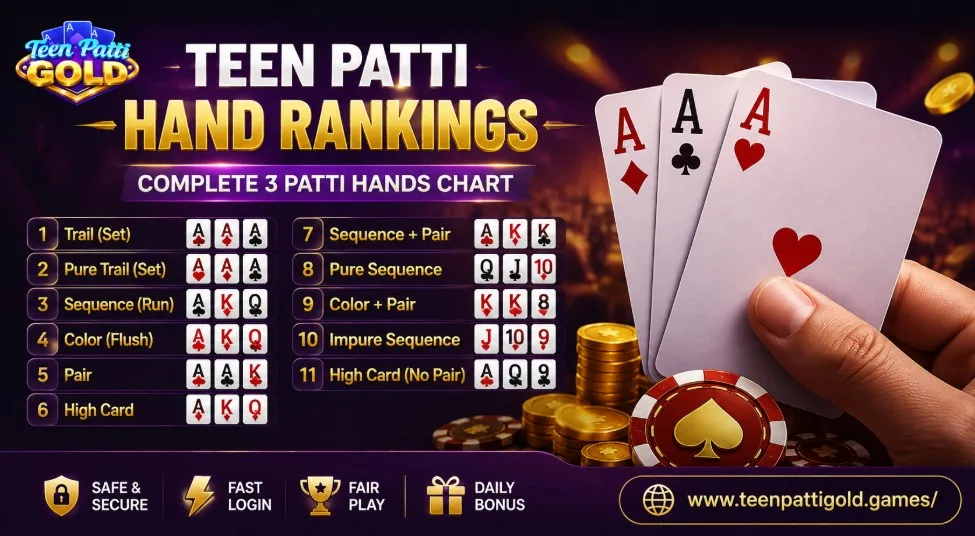
Teen Patti Hand Rankings: Complete 3 Patti Hands Chart
Understanding Teen Patti hand rankings is one of the first things every new player should learn. The game uses three-card hands, and the strength of those cards determines the result when players reach a comparison or show. Without knowing the ranking order, it can be difficult to understand whether a hand is strong, average, or weak.
The standard Teen Patti hierarchy contains six main hand categories: Trail, Pure Sequence, Sequence, Color, Pair, and High Card. They are ranked from strongest to weakest.
This guide explains each Teen Patti hand with simple card examples, comparisons, tie-break situations, and common mistakes. Rules can vary between different tables and variations, so the specific rules of the game being played should always take priority.
What Are Teen Patti Hand Rankings?
Teen Patti hand rankings are the system used to compare three-card combinations.
The standard order from highest to lowest is:
Trail → Pure Sequence → Sequence → Color → Pair → High Card
This means a Trail beats a Pure Sequence, a Pure Sequence beats a Sequence, and so on.
For example, a Pair can beat a High Card, but it cannot beat a Color. Similarly, even a low-ranking Trail is normally stronger than a very high Pure Sequence because the hand category comes first.
Learning this order makes it much easier to understand the outcome of a Teen Patti round.
Teen Patti Hands From Highest to Lowest
Here is the standard hierarchy:
| Rank | Hand | Example |
|---|---|---|
| 1 | Trail | A-A-A |
| 2 | Pure Sequence | 7♥-8♥-9♥ |
| 3 | Sequence | 7♠-8♥-9♦ |
| 4 | Color | K♣-9♣-4♣ |
| 5 | Pair | Q♠-Q♦-5♣ |
| 6 | High Card | A♠-J♦-6♣ |
The important point is that the category is compared before individual card values.
1. Trail or Three of a Kind
A Trail is three cards of the same rank.
Examples include:
-
A-A-A
-
K-K-K
-
8-8-8
-
3-3-3
Trail is generally the highest standard hand in Teen Patti. Three Aces are normally considered the strongest Trail, while three Twos are normally the lowest.
If two players both have a Trail, the higher rank usually wins.
For example:
Player A: K-K-K
Player B: Q-Q-Q
Player A wins because Kings rank above Queens.
A Trail is powerful because all three cards share the same rank. It also beats every lower hand category.
2. Pure Sequence
A Pure Sequence contains three consecutive cards from the same suit.
For example:
5♥-6♥-7♥
All three cards are consecutive and all belong to hearts.
Other examples include:
-
4♠-5♠-6♠
-
8♦-9♦-10♦
-
J♣-Q♣-K♣
Pure Sequence is generally ranked below Trail and above an ordinary Sequence.
One important point is that sequence ordering can vary between house rules. Some common Teen Patti formats treat A-K-Q and A-2-3 as particularly strong sequences, while other formats may handle Ace sequences differently. Always check the specific rules being used.
3. Sequence
A Sequence consists of three consecutive cards that are not all from the same suit.
For example:
7♠-8♥-9♦
The ranks are consecutive, but the suits are different.
Other examples include:
-
5♣-6♦-7♠
-
9♥-10♣-J♦
-
Q♠-K♥-A♦
A Sequence is weaker than a Pure Sequence because the cards are not all from the same suit.
However, a Sequence is still stronger than a Color, Pair, or High Card under the standard hierarchy.
4. Color
A Color consists of three cards from the same suit that do not form a sequence.
For example:
K♠-9♠-4♠
All three cards are spades, but they are not consecutive.
Another example is:
A♥-8♥-3♥
Again, all cards are hearts without forming a sequence.
Color ranks below Sequence but above Pair and High Card in the standard Teen Patti hierarchy.
This is one of the areas where beginners can become confused. Having three cards of the same suit does not automatically make the hand a Pure Sequence. The cards must also be consecutive to qualify as a Pure Sequence.
5. Pair
A Pair contains two cards of the same rank and one different card.
Examples:
A-A-7
K-K-4
9-9-Q
The two matching cards form the Pair.
A Pair is stronger than a High Card but weaker than Color, Sequence, Pure Sequence, and Trail.
If two players have Pairs, the rank of the matching cards is normally compared first.
For example:
Player A: K-K-5
Player B: Q-Q-A
Player A normally wins because the Pair of Kings is higher than the Pair of Queens.
If both players have the same Pair, the remaining card can become important under the applicable tie-breaking rules.
6. High Card
A High Card is a hand that does not qualify as a Trail, Pure Sequence, Sequence, Color, or Pair.
Example:
A♠-J♦-6♣
There is no pair, no same-suit combination, and no qualifying sequence.
High Card is the lowest standard hand category.
However, a High Card hand can still win if every other active player has a weaker High Card or leaves the round.
When comparing two High Card hands, the highest card is normally considered first, followed by the next highest card if necessary.
Complete Teen Patti Ranking Order
For quick reference, remember:
1. Trail
2. Pure Sequence
3. Sequence
4. Color
5. Pair
6. High Card
A useful way to memorize the order is:
Three same → same-suit sequence → normal sequence → same suit → pair → nothing
This simple pattern can help beginners remember the hierarchy without memorizing complicated definitions.
Which Teen Patti Hand Beats Which?
The easiest comparison is:
| Your Hand | Beats |
|---|---|
| Trail | Every lower category |
| Pure Sequence | Sequence, Color, Pair, High Card |
| Sequence | Color, Pair, High Card |
| Color | Pair, High Card |
| Pair | High Card |
| High Card | Only weaker High Card |
For example, even a low Pair beats a High Card.
Similarly, a Sequence beats a Color even when the Color contains high individual cards.
The reason is that Teen Patti first compares the hand category, not simply the highest individual card.
Teen Patti Card Values
Card values are also important when two players have the same type of hand.
The usual ranking is:
Ace > King > Queen > Jack > 10 > 9 > 8 > 7 > 6 > 5 > 4 > 3 > 2
Ace is normally treated as the highest card.
However, Ace can also participate in certain sequences depending on the rules.
For example, some common Teen Patti rules recognize:
A-K-Q
and
A-2-3
as valid sequences.
The exact ordering of these Ace-based sequences can vary by format, so players should confirm the applicable rules before relying on a particular sequence hierarchy.
Is A-2-3 a Sequence in Teen Patti?
In many traditional Teen Patti rule sets, A-2-3 is a valid sequence.
However, its position in the sequence hierarchy is not completely universal. Some tables place A-2-3 immediately below A-K-Q, while other versions may handle Ace sequences differently.
This is why it is better not to assume that every Teen Patti table follows exactly the same sequence ordering.
If you are playing a particular online version, read the game’s rules before deciding how A-2-3 compares with another sequence.
Is K-A-2 a Valid Sequence?
In standard Teen Patti rules, K-A-2 is generally not treated as a valid sequence.
A valid sequence normally follows an accepted consecutive-card pattern.
For example:
A-K-Q — commonly valid
A-2-3 — commonly valid under many rules
K-Q-J — valid
Q-J-10 — valid
K-A-2 — generally not valid
Again, individual variations can introduce different rules.
How Are Two Trails Compared?
If two players both have Trails, the rank of the three matching cards determines the winner.
Example:
Player A: A-A-A
Player B: K-K-K
Player A wins.
Another example:
Player A: 8-8-8
Player B: 7-7-7
Player A wins.
The matching rank is the key comparison because both hands belong to the same category.
How Are Two Pairs Compared?
When both players have Pairs, compare the rank of the matching cards first.
Example:
Player A: J-J-4
Player B: 10-10-A
The Pair of Jacks is higher than the Pair of Tens, so Player A wins under standard comparison.
If the matching Pair is identical, the remaining card may be used as the tie-breaker according to the applicable rules.
For example:
Player A: 9-9-A
Player B: 9-9-K
Ace is higher than King, so Player A would normally win.
How Are High Card Hands Compared?
If neither player has a combination, compare the highest card.
Example:
Player A: A-J-6
Player B: K-Q-10
Player A wins because Ace is higher than King.
If both hands begin with the same highest card, compare the next card.
Example:
Player A: A-J-6
Player B: A-10-9
Both have Ace as their highest card. The next cards are Jack and 10, so Player A has the stronger High Card hand.
The exact comparison procedure should follow the rules of the table being used.
Pure Sequence vs Sequence
This is a common beginner question.
Suppose Player A has:
5♥-6♥-7♥
and Player B has:
8♠-9♦-10♣
Player A has a Pure Sequence.
Player B has a normal Sequence.
Even though Player B’s cards contain a higher individual sequence, the Pure Sequence category is stronger than the normal Sequence category.
Therefore, Player A’s hand is normally stronger.
This demonstrates why understanding categories is more important than simply looking at the highest card.
Color vs Pair
Consider:
Player A: A♣-8♣-4♣
Player B: K-K-2
Player A has a Color.
Player B has a Pair.
Under the standard hierarchy, Color ranks above Pair, so Player A has the stronger category.
This is another example where the hand type matters more than the individual card value.
Pair vs High Card
Consider:
Player A: 2-2-5
Player B: A-K-J
Player A has a Pair.
Player B has an Ace-high High Card.
The Pair is still stronger than High Card, so Player A’s hand normally wins.
This is one of the most important concepts for beginners because high cards can look attractive even when they do not form a stronger combination.
Common Teen Patti Hand Ranking Mistakes
Confusing Color and Pure Sequence
Three cards from the same suit are not automatically a Pure Sequence.
They must also be consecutive.
Thinking High Cards Always Win
An Ace is the highest individual card, but an Ace-high High Card does not beat a Pair or Color.
Forgetting the Category
Always compare the category first.
Applying Poker Rules
Teen Patti has its own three-card ranking structure. Poker rankings should not automatically be applied.
Ignoring House Rules
Some tables change sequence ordering, tie rules, or other details.
Always check the specific rules before playing.
How Beginners Can Memorize Teen Patti Hands
A simple memory method is to think of the hands in groups.
Trail: three identical ranks.
Pure Sequence: consecutive + same suit.
Sequence: consecutive.
Color: same suit.
Pair: two identical ranks.
High Card: none of the above.
Once these six definitions are familiar, identifying most standard Teen Patti hands becomes much easier.
Why Teen Patti Hand Rankings Matter
Hand rankings are more than a list to memorize. They are the foundation for understanding decisions during a round.
Knowing your hand category helps you understand:
-
How strong your cards are compared with common hand types
-
What another player’s hand might represent
-
Whether a particular action makes sense
-
Why one hand beats another during a show
-
How to interpret card combinations correctly
However, a strong hand ranking does not guarantee a particular outcome in every situation. Teen Patti also involves uncertainty, and different game formats can introduce additional rules.
Are Teen Patti Hand Rankings the Same Everywhere?
The main six-category hierarchy is widely used:
Trail → Pure Sequence → Sequence → Color → Pair → High Card
But specific details can differ.
Possible variations include:
-
Ace sequence ordering
-
Tie-breaking rules
-
Suit ranking
-
Joker or wild-card variations
-
Betting structure
-
Show rules
-
Sideshow rules
For this reason, players should read the rules of the specific version they are using instead of assuming every table works identically.
Frequently Asked Questions
What is the highest Teen Patti hand?
Trail, or three of a kind, is generally the highest standard Teen Patti hand. Three Aces are normally the strongest Trail.
What is the lowest Teen Patti hand?
High Card is the lowest standard hand category.
Does a Pair beat a High Card?
Yes. Under the standard ranking, Pair is stronger than High Card.
Does Color beat Sequence?
No. In the standard Teen Patti hierarchy, Sequence ranks above Color.
Does Pure Sequence beat Trail?
No. Trail ranks above Pure Sequence in the standard hierarchy.
What is the difference between Color and Pure Sequence?
Color means three cards of the same suit. Pure Sequence means three consecutive cards of the same suit.
Is A-2-3 a valid Teen Patti sequence?
A-2-3 is valid in many traditional Teen Patti rule sets, but its exact position can vary between formats.
Is K-A-2 a valid sequence?
K-A-2 is generally not considered a valid standard Teen Patti sequence.
How are two Pairs compared?
The rank of the matching pair is normally compared first. If the pair is identical, the remaining card may be used as a tie-breaker under the applicable rules.
Can an Ace-high hand beat a Pair?
No. An Ace-high High Card is still a High Card hand, and a Pair ranks above it.
Final Thoughts
Learning Teen Patti hand rankings gives beginners the foundation they need to understand the game. The standard order is straightforward:
Trail → Pure Sequence → Sequence → Color → Pair → High Card
The key is to identify the hand category before comparing individual card values. A Pair beats a High Card, a Color beats a Pair, and a Sequence beats a Color under the standard hierarchy.
Remember that specific Teen Patti variations can change sequence ordering, tie-breakers, and other rules. If you are playing on an online platform or at a private table, check the applicable rules first.
Once you understand these six hand categories, the next step is learning how the cards are used during an actual round and how different gameplay decisions work.

Anu Thakur
Managing Director, Teen Patti Gold
About Me: I’m Anu Thakur, an experienced content writer and betting industry expert with over 8 years of hands-on experience in the betting niche. I specialize in creating insightful, well-researched content covering sports betting, fantasy platforms, odds analysis, match predictions, and betting strategies.
With a strong foundation in both writing and real-world betting knowledge, I deliver content that is accurate, engaging, and easy to understand for readers at all levels. Over the years, I have closely followed market trends, platform updates, and evolving betting regulations, allowing me to produce timely and trustworthy content.
My expertise lies in breaking down complex betting concepts into clear, actionable insights while promoting responsible betting practices. With a keen analytical approach and attention to detail, I aim to help readers make informed decisions and enhance their overall betting experience. My work reflects a deep passion for sports, data-driven analysis, and high-quality storytelling within the betting domain.